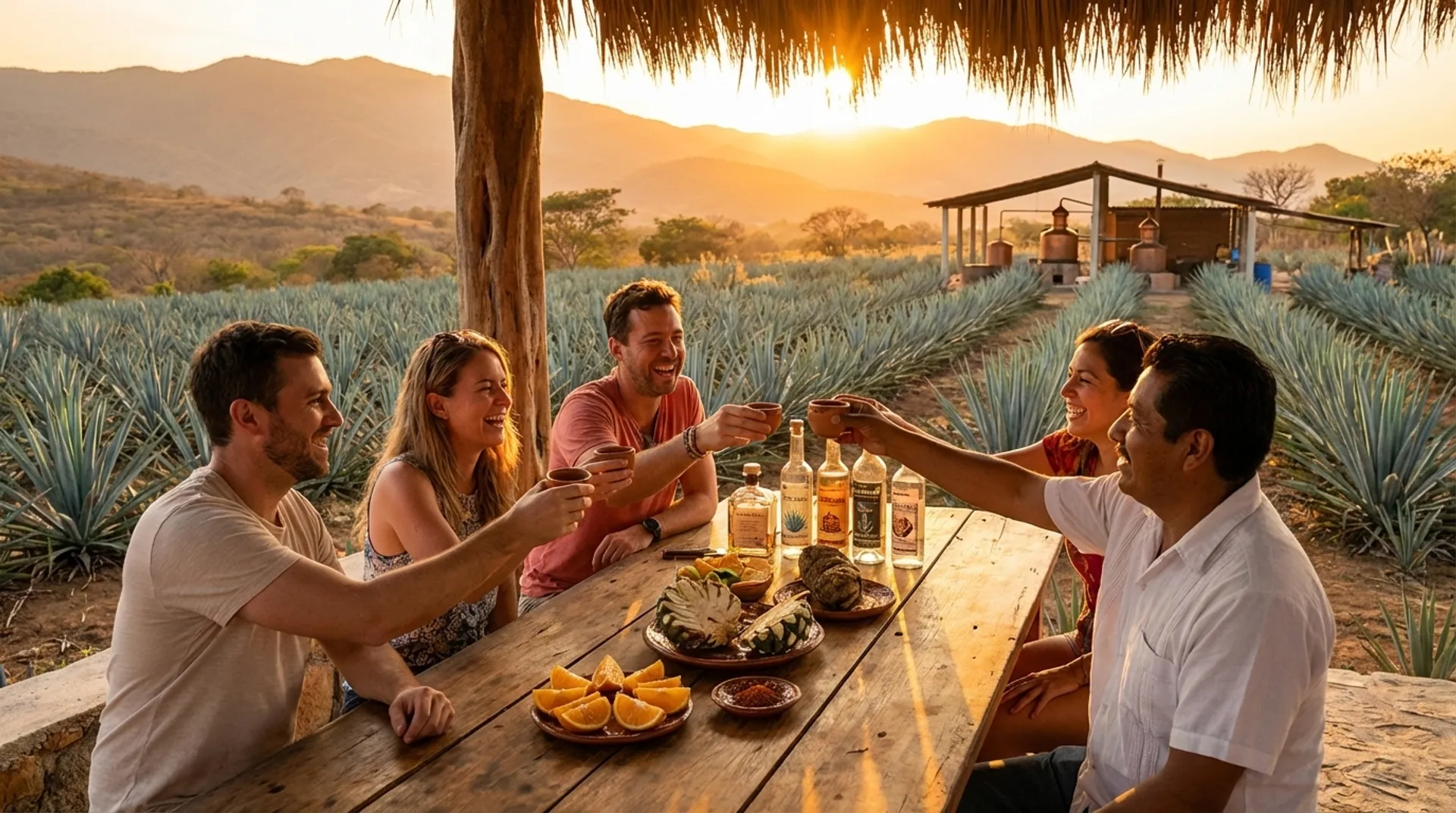

To understand why a bottle of Real Minero or Lalocura costs $100+, you have to grasp the suffering required to make it. You aren't buying liquid; you're buying the sweat of a family that waited 25 years for a harvest. Inefficiency drives the cost. Love drives the process.
The Process at a Glance
| Step | Spanish Name | Time Required | Goal |
|---|---|---|---|
| 1. Harvest | La Jima | 7-25 Years | Maturity & Sugar Peak |
| 2. Cooking | Horno Cónico | 3-5 Days | Smoky Sweetness |
| 3. Milling | Molienda / Tahona | 1 Day | Juice Extraction |
| 4. Fermentation | Fermentación | 3-10 Days | Wild Yeast Feast |
| 5. Distillation | Destilación | 2 Days | Purification |
1. The Harvest (La Jima)
Patience is the first ingredient. Grapes grow in a year. An Espadín agave waits seven. A wild Tepeztate? It watches a generation of children grow up before it's ready.
The "Castration" (El Capón)
First, the plant tries to flower. The Quiote shoots up. The farmer cuts it. Brutal, but necessary. This forces the sugar back into the heart instead of the flower. They let it soak up the sun for another year.
Finally, the Jimador steps in. One swing of the coa, leaves fall. What remains is the piña—massive, white, and weighing up to 300 lbs.
2. Cooking (The Earth Oven)
This is the scent of Oaxaca. You catch it miles away.
- Dig: A conical pit (Horno Cónico) opens the earth.
- Burn: Oak logs fire up until river stones glow red.
- Bury: Agave hearts pile on top.
- Seal: Dirt and wet fiber lock it tight.
The Alchemy: Underground, heat changes everything. The bitter white flesh caramelizes. It comes out sticky, brown, and tasting like roasted pumpkin candy.
3. Milling (The Tahona)
Now we crush it. The roasted piñas are sweet, but we need the juice.
In traditional Artesanal production, a horse pulls a one-ton volcanic stone (Tahona) in a slow circle. It gently squeezes the fiber.
Note: Go deeper into the mountains ("Ancestral" production), and you'll find men beating the agave with wooden mallets in a hollow log. It’s primitive, exhausting, and the only way they know.
4. Wild Fermentation
Factories use lab yeast to rush. Artisans trust the air.
Invisible Helpers
The crushed fiber and juice go into open wooden vats. No lids. We invite the Wild Ambient Yeasts floating in the breeze to feast. This is why mezcal tastes like here.
For a week, it bubbles and hisses. The sugar turns to alcohol, and the mash (Tepache) starts smelling like sourdough and ripe fruit.
5. Distillation
Fire meets liquid. The tepache goes into copper or clay stills. Vapor rises. Spirit drips.
- First Pass (Ordinario): Cloudy. Low strength.
- Second Pass (Rectification): Refined. Potent.
The Master's Tongue
Here, the Maestro proves his worth. He tastes the hazardous "Heads" and the watery "Tails," cutting them away to leave only the "Heart." No computers. Just a nose and a lifetime of practice.
💡 Truth in Bubbles
My favorite party trick? Ask a Maestro to check the ABV. He won't use a hydrometer.
He streams mezcal into a bowl and watches the bubbles (Perlas). A stable ring means the alcohol is perfect (45-55%). If they vanish instantly, it’s not ready. Physics confirms quality.
Smell the Smoke Yourself
Reading about it is one thing. Standing next to the roasting pit while warm mezcal drips from the copper still is life-changing.

AboutDiego Garcia
Senior Mezcal Reviewer & Industry Expert
Mezcal specialist with 15 years of experience in the Oaxacan spirits industry. Dedicated to preserving traditional production methods.
Read full profile & articles